No Curtain Required: How Artists Are Making the Creative Process the Main Event
For most of the twentieth century, the art world operated on a clear and largely unquestioned compact: artists made things in private, then presented finished results to the public. The studio was a sanctuary. The gallery was a stage. And the distance between the two was considered not merely practical but sacred.
That compact is dissolving.
Across the United States, a significant and growing cohort of artists is treating the act of making—the false starts, the abandoned sketches, the moments of genuine confusion—as the substance of their practice rather than its preamble. They are inviting audiences not to the conclusion of a creative journey but into its middle, its mess, and its unresolved tensions. In doing so, they are asking a deceptively simple question: What if the rehearsal was always the real performance?
The Studio as Stage
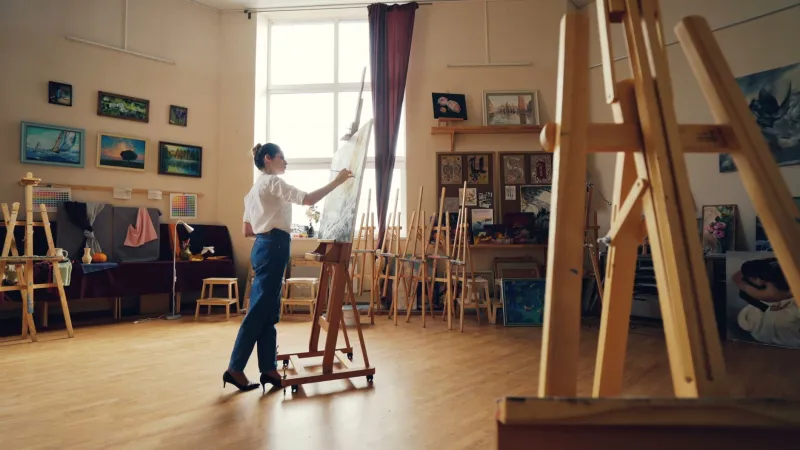
In Chicago, painter Dara Osei-Mensah has spent the past two years conducting what she calls "open process sessions" in her Pilsen studio, inviting small groups of visitors to sit with her while she works. There is no guided tour, no explanatory wall text, no finished piece to anchor the experience. Visitors watch Osei-Mensah paint, repaint, and sometimes destroy canvases she has spent weeks developing. Conversation is welcome but never required.
"People come expecting to see something complete," she said in a recent interview. "What they get instead is something alive. I think that alarms some of them and moves others in ways they didn't anticipate."
The response has been, by most measures, remarkable. Her sessions fill within hours of being announced, and a waiting list has persisted for months. The audiences who attend are not exclusively composed of art world insiders. Teachers, nurses, architects, and retirees have all found their way to her studio, drawn by something that conventional gallery programming rarely offers: the experience of witnessing genuine uncertainty.
Residencies Reconceived
Institutions are beginning to take note. Several prominent artist residency programs across the country are restructuring their public engagement models in response to this shift. The traditional residency model—artists work in isolation, then present finished or near-finished work at the program's conclusion—is giving way to something more porous.
At a residency program in rural Vermont, artists are now encouraged to schedule what the program calls "threshold events," informal gatherings in which residents share work at whatever stage it happens to be. No completion is required. No apology for incompletion is expected. The language itself is instructive: a threshold is neither an interior nor an exterior, but the charged space between them.
Similarly, a well-regarded visual arts residency in Marfa, Texas has begun hosting weekly "process meals," communal dinners at which residents speak about what they are struggling with rather than what they have accomplished. The format, borrowed loosely from certain therapeutic traditions, has reportedly produced some of the most generative peer conversations the program has seen in years.
Gallery Design Follows Suit
If residencies are changing how artists relate to their own process, galleries are beginning to change how audiences encounter it. A number of independent exhibition spaces in cities including Philadelphia, Oakland, and New Orleans have introduced what curators are calling "development galleries"—dedicated rooms within larger shows where process materials are displayed alongside, or sometimes instead of, finished works.
Sketchbooks, annotated drafts, discarded prototypes, and video documentation of studio sessions occupy these spaces with the same curatorial seriousness traditionally reserved for completed objects. The effect can be disorienting in the best possible sense. Viewers accustomed to approaching art with interpretive confidence find themselves in a more genuinely collaborative position, constructing meaning alongside an artist whose conclusions remain unresolved.
The critical reception has been mixed but energetic. Some reviewers have expressed skepticism, arguing that the valorization of process risks becoming its own form of aesthetic posturing—a new kind of finish disguised as the absence of one. Others have welcomed the shift as a necessary correction to a market culture that has long privileged the sellable object over the thinking that produced it.
What Audiences Are Actually Seeking
Underlying this movement is a broader cultural appetite that deserves serious attention. American audiences, particularly those who have come of age in an era of relentless digital curation, appear increasingly drawn to experiences that feel unmediated. Social media has made the performance of authenticity ubiquitous, but it has also, paradoxically, made genuine transparency more legible and more rare. Audiences have grown sophisticated enough to distinguish between the two.
What artists like Osei-Mensah are offering is not the performance of vulnerability but something closer to actual vulnerability—the willingness to be seen not knowing, not succeeding, not having arrived at the answer. This is, in a culture saturated with confident self-presentation, a genuinely radical offering.
It is also, it should be said, a form of labor that demands considerable courage. Artists who open their processes to public view are surrendering the protection that the private studio has historically provided. They are allowing failure to be witnessed, which means allowing failure to be judged. The artists who do this most compellingly tend to be those who have arrived at a settled enough sense of their own creative identity to tolerate the exposure—or who have decided, with clear eyes, that the exposure itself is the work.
The Question of Completion
All of this raises a philosophical question that the art world has long preferred to sidestep: What does it mean for a work to be finished? If the sketch that preceded the painting contains as much meaning as the painting itself—if the moment of hesitation before a brushstroke reveals as much about an artist's vision as the stroke that follows—then the traditional hierarchy of process and product begins to look like a cultural convention rather than a natural law.
Some artists working in this mode have begun to resist the language of completion altogether. They speak instead of "pausing" a work, or releasing it into the world at a particular moment in its development, with the understanding that it might continue to change—or that its incompleteness is itself the statement.
This is not, it bears emphasizing, an entirely new idea. Certain strands of conceptual and performance art have long interrogated the boundaries of the art object. What is new is the scale and accessibility of the current moment. These conversations are happening not only in graduate seminars and experimental gallery spaces but in community studios, public libraries, and church basements across the country.
The rehearsal, it turns out, has been the performance all along. It simply took audiences willing to show up before the curtain rose to make that visible.