Deliberate Obsolescence: Why American Artists Are Choosing Outmoded Tools as Acts of Creative Sovereignty
There is a particular sound a typewriter makes when a key strikes paper—a percussive, irreversible commitment that no digital keystroke can replicate. For Brooklyn-based poet and visual artist Dara Osei, that sound is not a relic. It is a declaration. "Every time I sit down at that machine," she explains, "I am choosing a relationship with my own intention that software actively discourages. There is no undo. There is no algorithm suggesting what comes next."
Osei is not alone. Across the United States, a quietly expanding movement of artists, printmakers, photographers, and musicians is making a conscious, sometimes defiant choice to work with technologies the mainstream market rendered obsolete long before the iPhone arrived. The tools vary—35mm film, hand-cranked letterpress, analog synthesizers, wax cylinder transcription, even mimeograph—but the underlying conviction is strikingly consistent: that the medium is never neutral, and that choosing a slower, more resistant material is itself a form of cultural argument.
The Philosophy of the Resistant Object
To understand why this matters, it helps to consider what digital tools actually do to creative practice. Contemporary software is, by design, optimized for frictionlessness. Interfaces are smoothed, errors are reversible, and algorithmic suggestion engines anticipate the user's next move before the user has fully formed it. For many artists, this seamlessness is not liberation—it is a subtle form of creative colonization.
Philosopher Albert Borgmann's concept of the "device paradigm" is instructive here. Borgmann argued decades ago that modern devices conceal their own workings, delivering commodified outcomes while severing the practitioner from the depth of engagement that older focal practices once demanded. What the letterpress printer, the darkroom photographer, or the vinyl-cutting engineer understands viscerally is that their tool has opinions—it pushes back, it demands skill, it introduces variables that cannot be entirely controlled. That resistance, many artists now argue, is not a deficiency. It is the point.
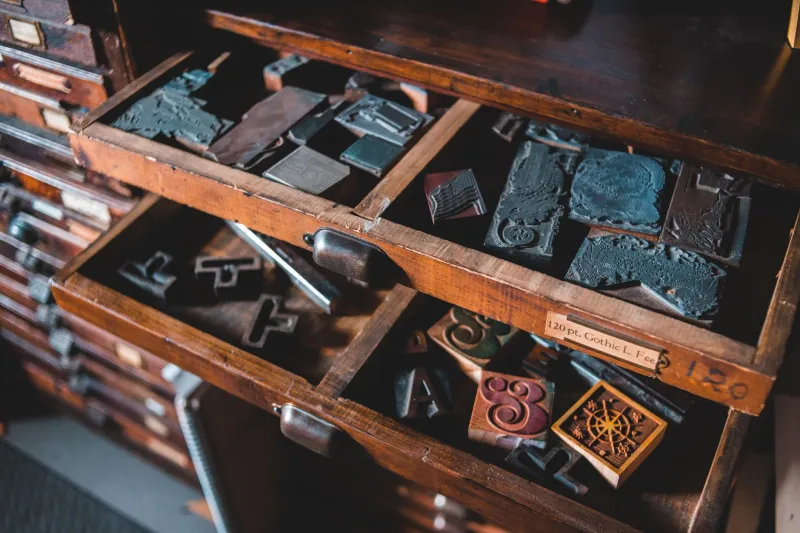
"There is a whole politics embedded in the idea that new is better," says Marcus Treviño, a Los Angeles-based printmaker who operates a letterpress studio out of a converted warehouse in Boyle Heights. "When I choose lead type over InDesign, I am not being quaint. I am refusing the assumption that efficiency should be the primary value governing how art gets made."
Vinyl, Film, and the Materiality of Memory
Perhaps nowhere is this tension more visible than in the resurgence of analog audio and film photography among younger American artists—a demographic that grew up entirely within digital culture and therefore cannot be accused of simple nostalgia.
For musicians working in experimental and indie spaces, the return to vinyl production and analog recording has less to do with warmth of sound—though that argument persists—and more to do with what the format demands of both maker and listener. A vinyl record cannot be shuffled. It has a side A and a side B. It rewards sustained attention and punishes distraction. In an era of streaming platforms engineered to fragment listening into individual tracks optimized for algorithmic placement, releasing music on vinyl is, for artists like Chicago-based composer Yemi Adaora, an insistence on narrative integrity.
"I want the listener to experience the work the way I composed it—as a sequence, as a journey," Adaora says. "Streaming doesn't allow for that. The platform becomes the curator, and the platform has no interest in my artistic vision. It has an interest in retention metrics."
Film photographers articulate a parallel logic. The finite roll—typically 24 or 36 exposures—introduces a scarcity that fundamentally alters the photographer's relationship to the subject. New Mexico-based documentary photographer Renata Szymański, who shoots exclusively on medium-format film, describes the constraint as clarifying rather than limiting. "When every frame costs something—money, time, chemicals, labor in the darkroom—you stop shooting reflexively. You start seeing differently. The slowing down is not a sacrifice. It is the entire practice."
Resistance Against Technological Determinism
What unites these practitioners across disciplines is a rejection of what scholars call technological determinism—the assumption that the adoption of new technologies is inevitable, natural, and inherently progressive. The artists profiled here are not Luddites in the pejorative sense; most use digital tools selectively and strategically. What they resist is the ideological claim that the latest platform or software represents an unambiguous advancement in human creative capacity.
This resistance carries particular urgency in the current moment. As generative artificial intelligence tools enter the creative marketplace with unprecedented speed, questions about authorship, intentionality, and the locus of creative agency have moved from theoretical to immediate. For many analog practitioners, their material choices have taken on a new valence—one that feels less like aesthetic preference and more like a line drawn in contested cultural ground.
"I think people are starting to understand that the choice of tool is a values statement," says Osei. "When I use a typewriter, I am saying: this came from a human body, in a specific moment, with specific limitations. That is not a weakness. That is what makes it art rather than output."
The Infrastructure of the Handmade
It would be a mistake to romanticize this movement without acknowledging its material conditions. Maintaining analog practice requires access to increasingly rare equipment, specialized knowledge, and supply chains that the market has largely abandoned. Darkroom chemicals are harder to source. Typewriter repair technicians are retiring without successors. Lead type is finite. The artists committed to these practices often spend considerable time and resources simply sustaining the infrastructure their work depends upon.
Yet many see this labor as inseparable from the artistic project itself. Treviño's Boyle Heights studio doubles as a teaching space, where he runs workshops for community members who have never encountered a letterpress. "Part of what I am doing is keeping a technology alive long enough to pass it on," he says. "That is a cultural act. It is archival work as much as it is artistic work."
This orientation toward transmission and preservation aligns the analog arts movement with broader progressive commitments to cultural sustainability—the understanding that certain forms of knowledge and practice, once lost, cannot simply be recovered by downloading an application.
The Futoransky Principle: Making Against the Current
At Luisa Futoransky Arts, we have long held that the most vital creative work is rarely produced by following the path of least resistance. The artists examined here embody that conviction with particular rigor. Their choice of outmoded tools is neither sentimental nor reactionary—it is a form of critical practice, a way of asking, with every keystroke and every exposure and every pull of the press, who benefits from the speed, and who bears the cost.
In a cultural landscape increasingly shaped by platforms designed to harvest attention rather than cultivate it, the deliberate embrace of the slow, the resistant, and the irreversible may be among the most genuinely radical gestures available to the contemporary American artist. Not because the past was better, but because the present deserves to be questioned—and sometimes, the most eloquent question is posed in a language the algorithm cannot parse.