Open Studio, Closed Door: How Today's Artists Are Mastering the Art of Strategic Revelation
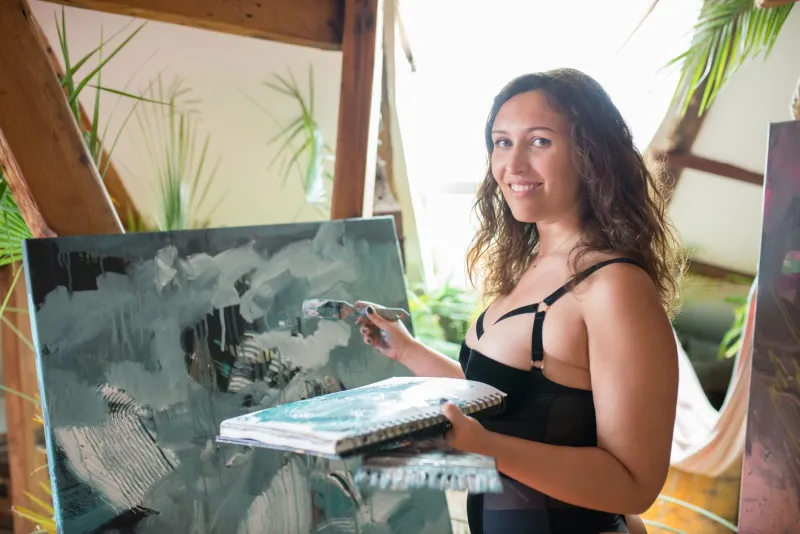
There is a particular kind of Instagram post that has become familiar to anyone who follows working artists online: the half-finished canvas, the studio corner strewn with reference materials, the sketchbook page photographed at an angle that reveals just enough to be intriguing. These images feel intimate. They feel honest. And yet, for many of the artists producing them, they are among the most carefully considered decisions in their entire practice.
Welcome to the collaboration paradox—the defining creative tension of our digital moment, in which the most innovative artists are simultaneously more visible and more guarded than any generation before them.
The New Architecture of Artistic Transparency
For much of art history, the studio was inviolable. What happened behind closed doors belonged to the artist alone, revealed only through the finished work presented to the world. That architecture has been dramatically altered by social media platforms that reward continuous disclosure, algorithmic feeds that privilege intimacy over formality, and audiences who have come to expect a relationship with creators that extends well beyond the gallery wall.
But the artists navigating this landscape most successfully are not simply flinging open the studio doors. They are building something far more deliberate: a curated threshold between the public and the private, a constructed transparency that invites viewers in while preserving the conditions under which genuine creative risk remains possible.
Chicago-based multidisciplinary artist Renata Osei describes her approach with characteristic precision. "What I share is never the actual problem I'm solving," she explains. "It's the evidence that a problem is being solved. There's a difference. One invites people into the energy of the work. The other gives away the architecture, and once you give that away, you can't get it back."
This distinction—between the atmosphere of creation and the mechanics of it—has become a kind of operating principle for a growing cohort of American artists working across visual art, performance, textile, and sound.
What Gets Shown, and Why
The decision about what to reveal is rarely arbitrary. For many artists, the materials, moods, and preliminary gestures that make their way onto public platforms serve a specific function: they create what might be called an emotional contract with the audience, establishing authenticity without surrendering agency.
New York-based sculptor and installation artist Marcus Delray has built a following of nearly two hundred thousand across platforms by sharing what he calls "process adjacencies"—the walks he takes before beginning a new piece, the music playing in his studio, the books stacked on his worktable. What he almost never shares is the actual fabrication process, the structural decisions, or the conceptual framework guiding a given work.
"People want to feel close to the thing being made," Delray says. "They don't necessarily need to understand how it's made. In fact, I think mystery is part of what makes them care when the finished work arrives. If you've shown everything, there's no arrival. There's just accumulation."
This notion of arrival—of preserving the conditions for genuine surprise—surfaces repeatedly in conversations with artists who have thought carefully about digital disclosure. The work-in-progress content functions as a kind of extended prologue, building investment without resolving tension.
The Integrity Question
Critics of this approach sometimes frame it as a form of performance, an artful manipulation of audience expectation that privileges brand-building over authentic creative exchange. It is a charge that artists in this space take seriously, even when they ultimately reject it.
Los Angeles-based painter and printmaker Soledad Vance is among those who have wrestled most publicly with the ethics of selective disclosure. "I spent a long time feeling like I was being dishonest," she admits. "Like if I wasn't showing everything, I was somehow deceiving the people who followed my work. But I came to understand that the private space of making is not something I owe anyone. What I owe them is the truth of the finished work. That's the real disclosure."
Vance's position reflects a broader reorientation among progressive artists who are pushing back against the extractive logic of platform culture—the assumption that visibility is owed, that process must be legible, that the artist's interior life is fair game for public consumption simply because the tools to share it exist.
The most ethically grounded version of this strategy, these artists suggest, is not about withholding for the sake of mystique. It is about recognizing that certain kinds of creative vulnerability require protection to survive.
Building in Public Without Dissolving in Public
There is also a practical dimension to this conversation that deserves attention. Artists who share their process too comprehensively often report a phenomenon that might be called creative contamination—the accumulation of external voices, unsolicited feedback, and ambient expectation that begins to interfere with the work itself.
Portland-based fiber artist and educator Juno Achebe began documenting her practice online in 2019 and found, within a year, that the audience's responses to her in-progress work were subtly reshaping her decisions. "I started making choices based on what had gotten a good reaction, rather than what the piece needed," she recalls. "I didn't notice it happening until I looked back at a body of work and realized I'd been optimizing for approval rather than truth."
Achebe subsequently restructured her online presence, sharing completed works and contextual reflections rather than real-time documentation of the making process. The shift, she reports, restored a quality of attention to her studio practice that she had not realized she'd lost.
Her experience points to something important: the artists who are most successfully navigating digital visibility are those who have identified, with considerable specificity, where their creative process is most susceptible to outside influence—and have built deliberate structures to protect those zones.
The Audience's Role in This New Compact
What is perhaps most striking about this evolving dynamic is the degree to which audiences have accepted, and even embraced, the terms of selective disclosure. Rather than feeling deceived by what they are not shown, many followers of artists who practice strategic transparency report a heightened sense of engagement with the finished work—a feeling that they have been genuinely invited into something, rather than simply marketed to.
This suggests that the hunger driving social media engagement with artists is not, at its core, a hunger for total access. It is a hunger for relationship—for the sense that the person making the work is real, that the process is genuine, and that the invitation to witness it is sincere.
The artists who understand this most clearly are those who have recognized that revelation and concealment are not opposites. They are partners. What is withheld gives weight to what is shared. The closed door makes the open window meaningful.
In this sense, the collaboration paradox is not a contradiction to be resolved but a creative tension to be inhabited—one that, when navigated with integrity and intention, may be producing some of the most honest art of our time.