Hands in the Material: Why Mastering Analog Craft Has Become the Most Defiant Statement in Contemporary American Art

Photo by Photo by Cord Allman on Unsplash on Unsplash
There is a particular sound that accompanies the pulling of a screen-print—the soft, decisive drag of the squeegee across a mesh frame, the brief resistance before ink surrenders to paper. It is a sound that has existed in American studios for over a century, yet today it carries a new resonance. For a rising generation of artists working in the United States, that sound represents something the digital workspace cannot offer: the irreducible presence of a body making a decision it cannot undo.
Across the country, from the converted lofts of Chicago's Pilsen neighborhood to the high desert studios of Santa Fe, artists are not simply rediscovering traditional techniques. They are wielding them with deliberate, even polemical, intent. The return to analog craft—printmaking, hand-weaving, wheel-thrown ceramics, hand-lettered musical scores—is no longer the province of the sentimental or the technophobic. It has become one of the most intellectually serious positions an artist can occupy in the current cultural moment.
The Friction Is the Point
Digital tools have granted artists an extraordinary range of capacities: infinite revision, seamless replication, instantaneous global distribution. These are genuine freedoms, and no serious observer dismisses them. But freedom from consequence, artists are discovering, is not the same as creative liberation. The command-Z function—the ability to undo any mark, reverse any decision—has introduced into the studio a subtle but corrosive anxiety. When nothing is permanent, every choice becomes provisional, and the cumulative weight of provisional choices can hollow out a practice.
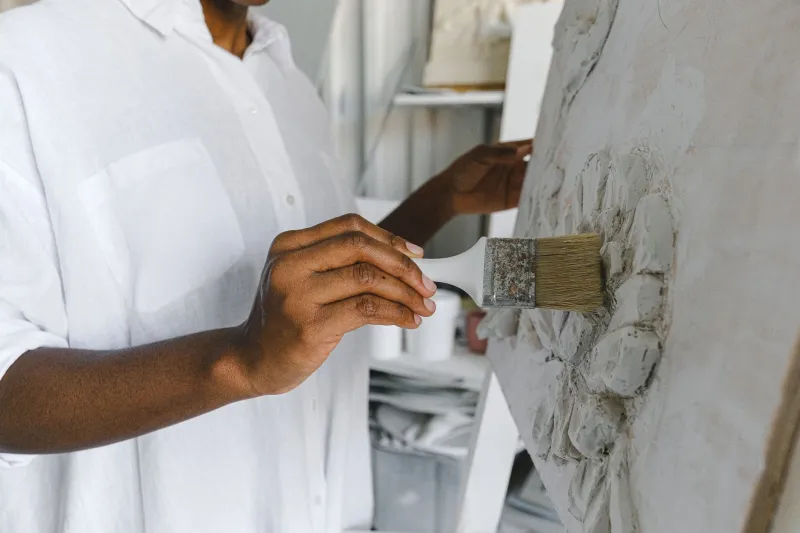
Physical media operates under a different logic entirely. A woodblock, once carved, holds its incisions. A ceramic vessel, once fired, carries the memory of every finger pressure, every uneven wall, every crack that sealed itself in the kiln's heat. Woven textiles record the tension of the weaver's hands across their entire surface. These are not defects to be corrected but truths to be inhabited. The material becomes a collaborator with genuine authority—one that pushes back, refuses, and occasionally surprises.
Mariana Solís, a textile artist based in Los Angeles whose large-format tapestries have drawn significant institutional attention over the past three years, describes the shift in terms of accountability. "When I was working primarily in digital collage, I could always defer the final decision," she has explained in conversation with peers. "The loom doesn't allow deferral. Every pass of the shuttle is a commitment, and you learn to think differently when commitment is the only option available to you."
Time as a Creative Medium
One of the most profound distinctions between analog and digital practice is their respective relationships to time. A digital composition can be assembled, disassembled, and reassembled in hours. A hand-thrown ceramic series demands weeks of preparation, forming, drying, bisque firing, glazing, and final firing—a sequence that cannot be compressed without consequence. Printmaking, particularly intaglio or lithography, requires a similar patience: the careful preparation of the plate or stone, the precise mixing of inks, the methodical registration of each pass through the press.
For younger artists who came of age in an environment of accelerated digital production, this enforced slowness is not a hardship. It is, as many describe it, a revelation. The extended duration of analog processes creates space for reflection that faster workflows preclude. Ideas that might have been discarded in a digital environment—deemed insufficiently resolved or commercially viable—are allowed to mature over the weeks a physical work demands.
Jerome Whitfield, a printmaker in his late twenties working out of a shared studio in Philadelphia, has spoken about the way the press changed his understanding of his own intentions. "You spend three weeks preparing a plate, and somewhere in that time you figure out what you actually think about the image. The process interrogates you. By the time you pull the first proof, you know the work better than you ever could have if you'd just rendered it on screen."
Failure as Information
Analog practice reframes failure in ways that have significant creative consequences. In a digital environment, the failed experiment is deleted—it leaves no trace, generates no knowledge beyond the moment of its rejection. In physical media, failure is frequently preserved in the object itself, and those preserved failures often contain the most generative information a work can offer.
A ceramic vessel that cracks during firing and is repaired with gold-infused lacquer in the Japanese kintsugi tradition does not conceal its history; it displays it as a form of beauty. A monotype print that pulls unevenly, leaving ghost images and unexpected tonal variations, may produce precisely the atmospheric quality the artist had been seeking without knowing it. Weavers speak of the "happy accident" of a dropped thread or a miscounted warp as a moment when the textile reveals a direction the maker had not consciously chosen.
This is not romanticism about imperfection. It is a sophisticated understanding of how creative intelligence operates in dialogue with resistant material. The mistake is not the enemy of the work; under the right conditions, it is its most honest collaborator.
Resistance as Cultural Argument
The choice to work in analog media today is never purely aesthetic. It is also a cultural argument—a position taken in relation to the broader conditions of contemporary art production. In an ecosystem increasingly shaped by algorithmic visibility, rapid content cycles, and the imperative to produce work that photographs well for social media distribution, the slow, material, physically particular object represents a deliberate refusal.
This refusal carries specific political valences. Many of the artists most committed to analog practice in the current moment are artists of color, Indigenous artists, and artists from working-class backgrounds who find in traditional craft forms a connection to lineages of making that were systematically excluded from the dominant art-historical narrative. For these practitioners, the return to weaving, ceramics, or hand-printing is also a return to ancestral knowledge systems—a reclamation of technical intelligence that the Western fine art tradition long refused to recognize as art at all.
The progressive cultural institutions that have been most attentive to this shift understand it in precisely these terms. When a major American museum presents a survey of contemporary craft alongside canonical painting and sculpture, it is not simply acknowledging a stylistic trend. It is revising its account of what counts as creative seriousness.
The Studio as Counterculture
What is perhaps most striking about the current analog revival is its generational character. The artists most ardently committed to physical craft are, in many cases, the artists most fluent in digital tools—practitioners who could easily work in either register and have made a considered choice. For them, the studio is not a refuge from the contemporary world but a site of active engagement with its contradictions.
The hand that pulls the squeegee, throws the clay, threads the loom, or notates a score in ink on paper is not a hand reaching backward. It is a hand insisting on the irreplaceable weight of the present moment—on the fact that some truths can only be made, slowly and with full accountability, in contact with the physical world. In the current cultural climate, that insistence may be the most radical gesture available to an American artist.