The Studio Speaks: Why Artists Are Abandoning Screen-Based Feedback for the Irreplaceable Power of Physical Presence
The Limits of the Like Button
There is a particular kind of silence that descends in a studio when someone stands before a new work and says nothing for a full minute. It is not the silence of indifference. It is the silence of genuine encounter—a pause that carries within it the entire weight of a viewer's attention, their confusion, their recognition, their resistance. No comment thread, however thoughtful, has yet found a way to replicate it.
Across the United States, a growing number of artists are arriving at this conclusion not as a romantic gesture toward the past but as a practical response to an observable problem. Digital feedback, for all its convenience and reach, has proven structurally ill-suited to the demands of serious creative development. The result is a quiet but determined resurgence of in-person critique circles, scheduled studio visits, and face-to-face artistic dialogue—practices that many had presumed the pandemic had permanently retired.
They were wrong. And the reasons why illuminate something fundamental about the nature of art itself.
What Remote Feedback Cannot Carry
When a painting is photographed and uploaded for online critique, something is invariably lost in translation. Scale collapses. Texture disappears. The relationship between a work and the space it inhabits—the way light falls across a surface at a particular hour, the way a sculpture commands or relinquishes a corner of a room—becomes entirely inaccessible. Artists who have participated in both digital and in-person feedback sessions frequently describe the former as useful for logistics and the latter as essential for truth.
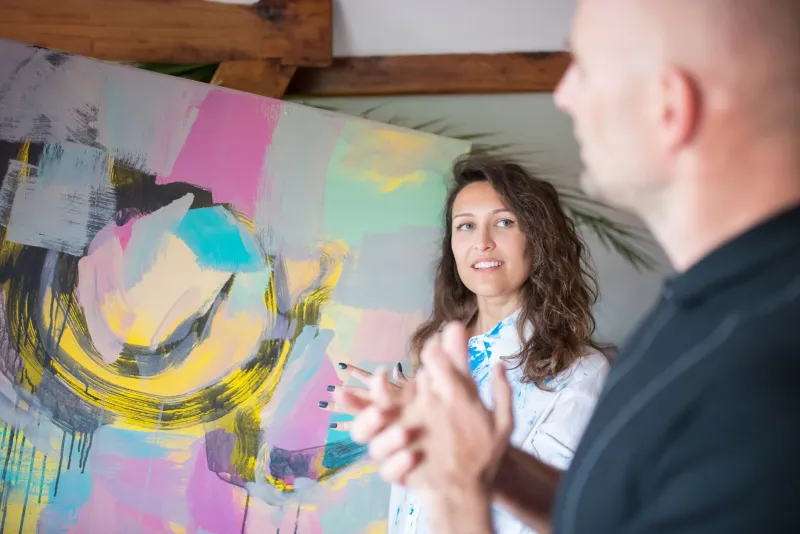
"You can tell someone a lot through a screen," says one New York–based painter who recently revived a monthly critique group that had gone dormant during the pandemic. "But you cannot show them what a painting is actually doing. That requires presence. It requires them to move toward it and away from it and around it."
Beyond the purely perceptual limitations, digital platforms introduce a layer of social mediation that tends to soften critique into something more palatable and, consequently, less useful. The architecture of most online spaces rewards affirmation. Algorithms amplify engagement, and engagement, almost universally, means approval. Artists operating within these environments report a persistent tendency toward encouragement at the expense of rigor—a dynamic that feels supportive in the short term but ultimately impedes genuine growth.
Accountability and the Embodied Exchange
In-person critique operates under a different set of social pressures, and they are, paradoxically, more productive ones. When a colleague looks directly at you and articulates a specific, difficult observation about your work, the exchange carries a weight that typed words simply do not. There is nowhere to retreat, no screen to close, no notification to defer. The conversation demands your full presence, and that demand is itself a form of respect.
This quality of mutual accountability has emerged as one of the most frequently cited reasons artists are returning to physical critique formats. In cities including Chicago, Los Angeles, Philadelphia, and Portland, informal critique circles have reconstituted themselves in studios, community arts spaces, and occasionally in the back rooms of galleries willing to host them. Some groups meet monthly; others gather weekly. What they share is a commitment to the unmediated encounter as the foundation of serious artistic conversation.
The bonds that form within these circles extend well beyond the critique session itself. Artists describe developing a vocabulary specific to their group—a shared set of references, concerns, and aesthetic commitments that deepens over time in ways that online communities, with their high turnover and diffuse membership, rarely sustain. The intimacy of the studio visit, in particular, creates conditions for a kind of trust that is difficult to manufacture at a distance.
The Studio Visit Reimagined
The studio visit has long occupied a peculiar position in the American art world—simultaneously intimate and professional, personal and evaluative. For much of the twentieth century, it served as the primary mechanism through which artists built relationships with curators, critics, collectors, and peers. The rise of digital communication diminished its frequency without eliminating its importance, and the pandemic years reduced it further still.
What is emerging now is not simply a restoration of pre-pandemic norms but something more intentional. Artists who have experienced both the convenience of digital exchange and the depth of physical encounter are making deliberate choices about when each mode is appropriate—and increasingly reserving their most serious creative conversations for the studio.
Some are formalizing this commitment in novel ways. Residency programs across the country have begun incorporating structured peer critique sessions as a central component of their offerings, recognizing that the opportunity for sustained, in-person dialogue is itself a significant draw for applicants. Others are organizing visiting artist programs that emphasize extended studio time over public lectures, prioritizing the private, unhurried conversation over the performed presentation.
A Pushback Against the Algorithmic Gaze
Underlying this movement is a broader critique of the role that digital platforms have come to play in shaping artistic identity and reception. When an artist's work is primarily encountered through social media, it is inevitably shaped—consciously or not—by the logic of those platforms. Images are composed for the scroll. Series are structured for the feed. The work begins to address an imagined audience of followers rather than the more demanding, less predictable audience of people standing in a room.
In-person critique offers a corrective to this tendency. It restores the work to its proper scale, returns it to a physical context, and subjects it to a form of attention that cannot be gamed or optimized. The viewer in the studio cannot be targeted. They cannot be algorithmically selected for their likelihood to respond positively. They are simply there, with their full subjectivity, their genuine reactions, and their willingness—when the group is functioning well—to say what they actually see.
For many artists, this is precisely the point. The return to in-person critique is, among other things, a reclamation of the work itself from the distortions imposed by digital circulation.
Presence as Practice
There is something worth noting in the fact that this resurgence is being led, in significant part, by younger artists—those for whom digital tools are not novelties but native environments. The choice to prioritize in-person dialogue is not, for them, a nostalgic one. It is a considered aesthetic and ethical position, arrived at through direct experience of both modes.
What they are articulating, in studios and critique circles from Brooklyn to Albuquerque, is a conviction that the depth of creative community cannot be adequately sustained through screens alone. That genuine accountability requires physical co-presence. That the most important conversations about art happen in the places where art is made, with people who are willing to stand in front of it and tell the truth.
The studio, it turns out, has not been replaced. It has been waiting.