Knowledge Without Walls: The New Apprenticeship Reshaping American Art
For much of the twentieth century, the path to becoming a serious artist in America ran through a predictable set of checkpoints: the undergraduate portfolio review, the graduate school application, the thesis exhibition, the gallery introduction. This pipeline was not without its genuine merits — rigorous critique, peer community, institutional credibility. But it was also, by design or consequence, exclusionary. Tuition debt, geographic limitation, and the cultural biases embedded in admissions committees meant that enormous swaths of creative talent never entered the room at all.
Something different is happening now. Across the country, from the ceramics studios of rural New Mexico to the converted warehouses of Detroit and the shared digital spaces connecting artists from Appalachia to the Gulf Coast, a new model of artistic transmission is taking shape. It does not have a formal name, a curriculum committee, or an accreditation body. What it has is something older and arguably more essential: the direct passage of knowledge from one working artist to another.
Reclaiming an Ancient Model
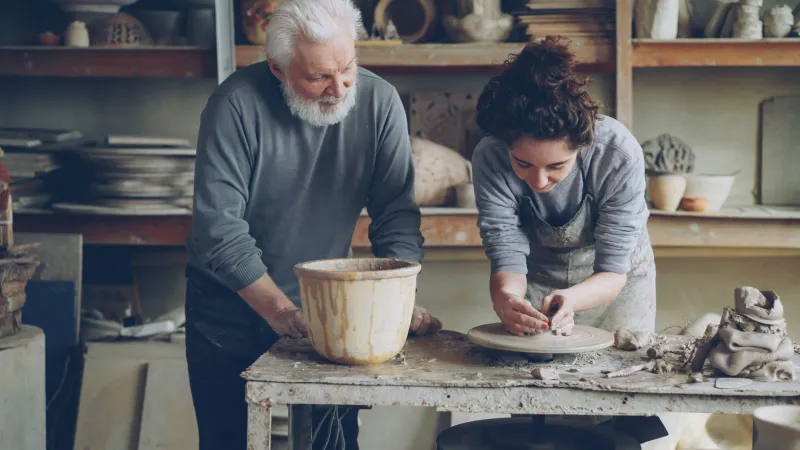
The apprenticeship is not a new invention. For centuries, before the academy displaced the guild, artists learned their craft through proximity — grinding pigments, stretching canvases, watching a master's hand move across a surface until the gesture became legible and eventually reproducible. What the twentieth-century institution offered in exchange for this model was legitimacy, a credential that could be presented to the art world as proof of seriousness.
The artists now reconstructing informal apprenticeship structures are not naive about what they are forgoing. They understand that the MFA carries weight in certain rooms. What they are questioning, with increasing conviction, is whether those rooms are the only ones worth entering — and whether the credential is worth its considerable cost, financial and otherwise.
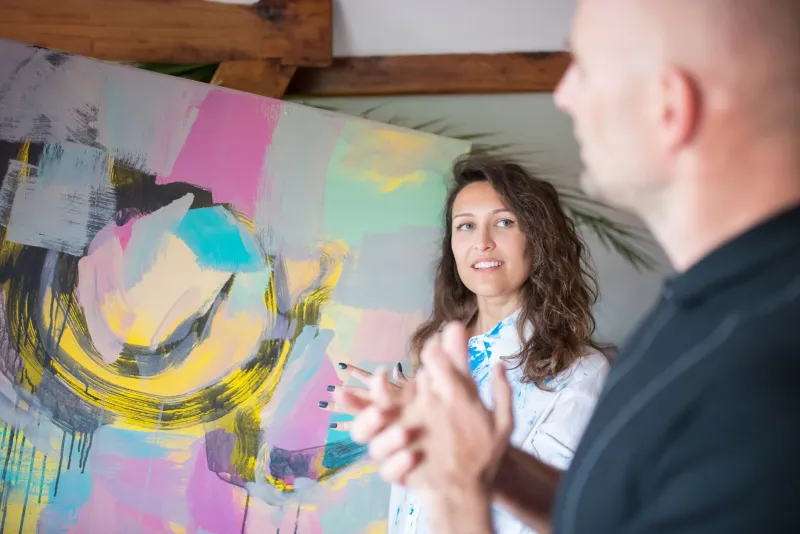
In Chicago, printmaker and educator Yolanda Ferris has spent the past six years hosting what she calls "studio residencies without paperwork" — month-long arrangements in which emerging artists work alongside her in exchange for contributing labor to ongoing projects. There are no formal evaluations, no syllabi, no grades. There is, instead, a daily negotiation of process and decision-making that Ferris describes as "the education that happens when you can't hide behind an assignment."
"The MFA teaches you to talk about your work," she says. "What I try to offer is the experience of actually doing it under pressure, with someone who will tell you when something isn't working and why."
Digital Networks as Transmission Channels
If the studio exchange represents one pole of this emerging ecosystem, the digital network represents another — and its implications for geographic equity are profound. Platforms built around video, live streaming, and asynchronous communication have made it possible for a self-taught sculptor in rural Mississippi to study alongside a master woodworker in Vermont, or for a young painter in Phoenix to receive sustained mentorship from an established artist in Brooklyn without either party relocating.
This is not the passive consumption of tutorial content, though that too has its place. The most meaningful of these digital mentorships involve structured correspondence, shared critique sessions conducted over video, and the deliberate cultivation of a relationship that mirrors, in its intimacy and accountability, what the guild system once provided in physical space.
Organizations like the Craft Emergency Relief Fund and various regional artist-in-residence networks have begun formalizing some of these connections, offering modest stipends and structured frameworks to what might otherwise remain ad hoc arrangements. But many practitioners argue that the power of informal mentorship lies precisely in its resistance to institutionalization — that the moment it acquires bureaucratic scaffolding, something essential is lost.
Craft as Cultural Continuity
For artists whose practices are rooted in specific cultural traditions — Indigenous beadwork, African American quilting lineages, Latinx folk art forms — the stakes of non-institutional transmission extend well beyond individual skill development. These are communities for whom the formal art world has historically functioned as an extractive force, commodifying aesthetic traditions while systematically excluding their originators from positions of economic or institutional power.
In this context, the informal apprenticeship becomes something more than a pedagogical preference. It becomes an act of cultural sovereignty — a refusal to allow knowledge systems developed over generations to be filtered through institutions that have demonstrated neither the capacity nor the consistent will to steward them faithfully.
Weaver and community organizer Delia Tsosie, based in northern Arizona, has spent years documenting and transmitting Diné weaving practices through a network of intergenerational workshops that deliberately bypass gallery and museum frameworks. "The institution wants the object," she has noted in public conversations about her work. "What we are protecting is the understanding behind the object — the decisions, the relationships, the reasons. That doesn't belong on a wall. It belongs in the hands."
The Question of Legitimacy
The tension at the center of this movement is one that its participants navigate with varying degrees of comfort: the question of whether work produced and practitioners formed outside institutional structures will be recognized, collected, written about, and compensated on equitable terms.
There is honest disagreement here. Some artists argue that the art world's gatekeeping apparatus is sufficiently eroded — by social media, by the proliferation of independent art fairs, by the growing market for work rooted in community and cultural specificity — that the credential matters far less than it once did. Others maintain that structural inequities remain deeply entrenched, and that artists from marginalized communities who opt out of institutional pathways do so at genuine professional risk.
What both perspectives share is a recognition that the conversation itself is changing. The question is no longer simply "did you go to graduate school" but increasingly "what do you know, how did you learn it, and who did you learn it alongside?"
A Living Curriculum
What distinguishes the most vital of these informal apprenticeship networks is their insistence on reciprocity. Unlike the traditional mentor-student hierarchy, many of the arrangements now proliferating across American art communities are explicitly structured as exchanges — in which the emerging artist brings something to the relationship beyond tuition dollars or free labor, and in which the established artist is understood to be learning as well.
This model of mutual transmission is, perhaps, the most genuinely radical aspect of what is unfolding. It suggests that craft knowledge is not a fixed inheritance to be passed intact from one generation to the next, but a living conversation — one that changes in the telling, that gains complexity with each new voice that enters it, and that is most fully alive precisely when it cannot be contained within the walls of any single institution.
The artists building these networks are not, for the most part, making grand proclamations about dismantling the academy. They are doing something quieter and, in the long run, potentially more consequential: they are learning, and teaching, and creating the conditions under which the next generation of American artists might do the same — on terms that belong, finally, to themselves.