Sovereign Visions: Indigenous Artists Are Rewriting the Terms of Representation in American Museums
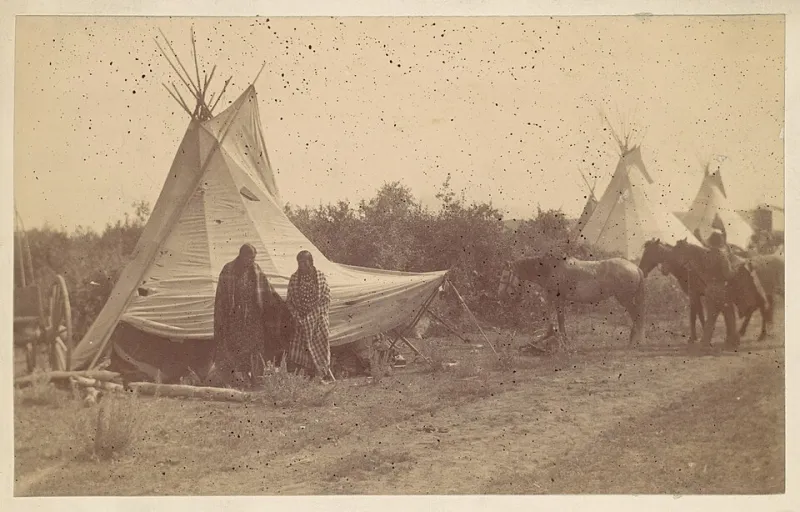
Photo: Unknown authorUnknown author, CC0, via Wikimedia Commons
There is a particular kind of erasure that operates not through absence but through presence — through the placement of sacred objects behind glass, through the curatorial language that transforms living cultures into archaeological artifacts, through the institutional habit of speaking about Indigenous peoples rather than with them. For well over a century, this form of erasure was the operative logic of American museums. It is a logic that a growing, formidable cohort of Indigenous artists, curators, and cultural advocates is now systematically dismantling.
The transformation unfolding across American cultural institutions is neither sudden nor accidental. It is the product of decades of advocacy, legal struggle — most notably the passage of the Native American Graves Protection and Repatriation Act of 1990 — and the sustained creative labor of Indigenous artists who refused to accept that their cultures could be authentically represented by those who had dispossessed them. What is new, and genuinely significant, is the scale at which this reckoning is now occurring, and the institutional seriousness with which it is being received.
The Problem With the Archive
To understand what Indigenous artists are pushing against, it is necessary to reckon honestly with what American museums have historically done. From the late nineteenth century onward, institutions including the Smithsonian, the American Museum of Natural History, and countless regional museums assembled vast collections of Indigenous material culture — ceremonial objects, ancestral remains, textiles, weapons, and artwork — through means that ranged from commercial purchase to outright seizure. These objects were then contextualized within frameworks drawn entirely from Western anthropological and aesthetic traditions, frameworks that consistently positioned Indigenous cultures as primitive, static, and — crucially — past.
The damage of this representational model extends beyond the symbolic. When a museum presents Lakota ceremonial regalia as historical artifact rather than as the property of a living spiritual tradition, it does not merely misrepresent that tradition — it actively participates in its suppression by reinforcing the public perception that Indigenous cultures are relics rather than realities. For Indigenous artists working today, this institutional inheritance is not a distant grievance. It is a daily professional and creative reality.
"Every time I walk into a major American museum, I am confronted with versions of my own culture that I do not recognize," reflects one prominent Diné (Navajo) painter whose large-scale works have been exhibited at institutions across the Southwest and the Northeast. "The question I keep asking is: who decided this is what we look like? Who decided this is what we mean?"
Artists Taking the Wheel
The answer, increasingly, is: Indigenous artists themselves. Across the country, a remarkable generation of creators is not merely producing work that responds to or subverts colonial representation — they are actively inserting themselves into the institutional processes that shape how that work is contextualized, exhibited, and received.
Jaune Quick-to-See Smith, a member of the Confederated Salish and Kootenai Tribes and one of the most celebrated Indigenous artists working in America today, has long used her practice to interrogate the commodification of Native identity. Her monumental canvases, which layer map imagery, found materials, and text in dense, politically charged compositions, do not simply depict Indigenous experience — they interrogate the mechanisms by which that experience has been packaged and sold to non-Native audiences. Her 2023 retrospective at the Whitney Museum of American Art, organized in close collaboration with the artist herself, was widely noted for the degree of curatorial authority Smith exercised over her own narrative — a model that felt, to many observers, like a quiet institutional revolution.
Similarly, the work of Cannupa Hanska Luger, a multidisciplinary artist of Mandan, Hidatsa, Arikara, Lakota, and European descent, operates at the intersection of performance, sculpture, and community organizing. His large-scale collaborative projects — including the Mirror Shield Project, which equipped water protectors at Standing Rock with reflective shields that turned surveillance back on those wielding it — challenge the very premise that Indigenous art exists for the contemplation of non-Native viewers. His work demands active engagement, moral accountability, and an acknowledgment that the creation of art is inseparable from the assertion of political sovereignty.
The Institutional Response
American museums are responding to these pressures with varying degrees of urgency and sincerity. The most substantive changes are occurring at institutions that have moved beyond symbolic gestures toward structural reform — revising curatorial practices, hiring Indigenous staff at senior levels, and fundamentally reconsidering the terms under which Indigenous collections are held and displayed.
The National Museum of the American Indian, a Smithsonian institution with locations in Washington, D.C., and New York City, has operated from its founding on a model of Indigenous collaboration and self-representation that remains exceptional in the American museum landscape. Its exhibitions are developed in active partnership with tribal nations, and its interpretive frameworks are drawn from Indigenous intellectual traditions rather than imposed from without. For many advocates, it represents not a ceiling of ambition but a floor — a baseline that all American cultural institutions should be working toward.
Elsewhere, progress is more uneven. Several major natural history museums have faced sustained criticism for the pace of their NAGPRA compliance — the legal process through which ancestral remains and sacred objects are returned to their communities of origin. The failure to fully implement repatriation obligations is not merely a bureaucratic shortcoming; it is, Indigenous advocates argue, a continuation of the original dispossession by other means.
What Authentic Representation Requires
The question of what genuine representational justice looks like in practice is one that resists easy resolution. It requires, at minimum, that Indigenous artists and communities hold meaningful authority — not merely advisory input — over how their cultures are presented in institutional contexts. It requires curatorial language that acknowledges the living, dynamic nature of Indigenous traditions rather than embalming them in the past tense. And it requires a willingness on the part of institutions to sit with discomfort: to acknowledge the colonial histories that made their collections possible, and to accept that acknowledging those histories will sometimes mean relinquishing objects, narratives, and authority.
For the artists at the center of this movement, the work is simultaneously creative and political — an insistence that the two have never, in fact, been separable. Their canvases, sculptures, performances, and installations are not simply beautiful objects. They are arguments, made in the language of art, about who gets to tell the story of a people, and on whose terms that story is told.
At Luisa Futoransky Arts, we are committed to amplifying those arguments — and to recognizing that the health of American cultural life depends, in no small measure, on whether its institutions are willing to listen.