Unguarded: How Artists Without Credentials Are Doing the Work Professionals Fear
There is a particular kind of courage that emerges only in the absence of consequence. It is the courage of the person who has not yet learned to be afraid—or, more precisely, who has never been given a reason to protect something they have not yet accumulated. In the American art world, where careers are built incrementally on institutional endorsements, gallery relationships, and the slow accrual of critical attention, this kind of fearlessness has become increasingly rare among those who have the most to offer. Yet it is flourishing, quietly and with remarkable vitality, in garages, community centers, church basements, and spare bedrooms across the country.
The paradox at the heart of contemporary creative culture is this: the more an artist has to lose, the less willing they often are to risk losing it. And the less an artist has invested in the machinery of professional validation, the more freely they tend to operate within the actual substance of their work.
The Weight of the Credential
To understand what amateur artists are escaping, it is necessary to understand what professional artists carry. A painter represented by a mid-tier gallery in a major American city is not simply a person who makes paintings. She is also a brand, a market position, a set of collector expectations, and a critical narrative that has been carefully constructed over years of strategic exhibition. Every new work she produces must negotiate with that accumulated identity. Departure from established style risks alienating buyers. Experimentation with unfamiliar materials invites skeptical reviews. Even the decision to work smaller, or slower, or in a mode that does not photograph well for Instagram, carries professional weight.
None of this is cynical. It is simply the structural reality of operating within an economy. But the consequence, as many working artists will acknowledge in private conversation, is a kind of creative self-censorship that tightens almost imperceptibly over time.
Marcos Delgado, a ceramicist based in Albuquerque who spent twelve years navigating the Southwest gallery circuit before stepping back from professional exhibition entirely, describes the shift with unusual candor. "I stopped making the weird stuff," he says. "Not because anyone told me to. But because I knew what sold, and I knew what got written about, and I just—gradually—stopped going anywhere else. When I finally made something genuinely strange again, it was in my garage at two in the morning, and I didn't tell anyone about it for six months."
Permission Structures and Their Absence
Amateur artists, by definition, have not been granted permission by the institutional art world to consider themselves serious practitioners. This exclusion, which can feel like a wound, functions in practice as a liberation. Without the framework of professional expectation, there is no established creative identity to protect, no collector relationship to honor, no gallery's program to fit within.
What fills that absence is something more elemental: curiosity, and the freedom to follow it wherever it leads.
Researchers in the psychology of creativity have long noted that intrinsic motivation—the drive to create for its own sake—produces more generative and exploratory work than extrinsic motivation, which is shaped by reward and evaluation. The professional art world is, almost by definition, a system of extrinsic motivators. Prizes, reviews, sales, residency fellowships—each of these is a form of external judgment that shapes behavior, often in ways the artist does not consciously register.
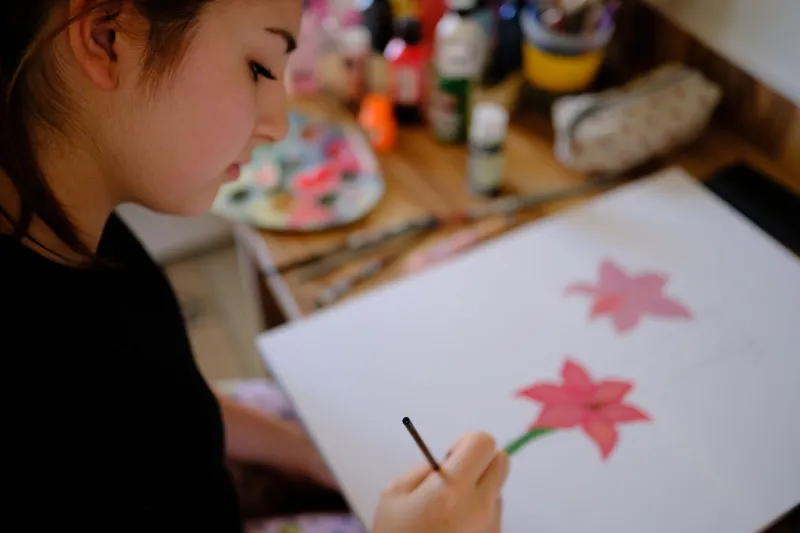
Amateur practice, operating largely outside this reward structure, tends to sustain intrinsic motivation more effectively. The artist making collages in her kitchen on Sunday mornings is not anticipating a review in Artforum. She is following a thread of interest because it interests her. That distinction, seemingly small, produces measurably different creative output.
Community Centers as Incubators
Across American cities and towns, community arts spaces have become unexpected laboratories for this kind of unencumbered practice. Programs at YMCAs, public library makerspaces, neighborhood cultural centers, and church-affiliated art groups bring together people of wildly varying backgrounds and skill levels with a single shared premise: that making things matters, regardless of what the professional world thinks of the result.
In these spaces, formal hierarchies dissolve. A retired schoolteacher experimenting with encaustic wax for the first time occupies the same table as a twenty-four-year-old who has never taken an art class. Neither carries the apparatus of professional identity. Both are, in the most unadorned sense, simply making.
Janelle Okafor, who facilitates a weekly mixed-media workshop at a community center in Columbus, Ohio, has observed the phenomenon from the inside for nearly a decade. "What I see in these rooms is a willingness to fail spectacularly," she says. "People try things that would embarrass a trained artist because they don't know they're supposed to be embarrassed. And sometimes those things are extraordinary. Sometimes they're doing something I've never seen before, not because they're geniuses, but because nobody told them it wasn't done."
What Professionals Might Reclaim
The argument here is not that amateur work is superior to professional work, or that training and rigor are obstacles to authentic expression. The most compelling creative practices tend to hold both discipline and freedom in productive tension. What the amateur moment illuminates is the cost of allowing professional identity to crowd out creative instinct—and the possibility of recovering something essential by temporarily setting that identity aside.
A number of established artists have begun doing exactly this, deliberately. They adopt pseudonyms to exhibit work in contexts where their reputations cannot precede them. They return to community workshops as participants rather than instructors. They impose on themselves the conditions of the beginner: unfamiliar materials, unfamiliar environments, the productive disorientation of not knowing what they are doing.
Delgado, for his part, has not returned to the gallery circuit. The work he makes in his garage—strange, formally unresolved, entirely uncommercial—is the work he considers most fully his own. "I don't know if it's good," he says. "I genuinely don't know. And that not-knowing is the most alive I've felt making work in fifteen years."
The Fearlessness Worth Studying
For an organization committed to the full breadth of American creative life, the amateur artist is not a footnote or a precursor to something more legitimate. She is a practitioner whose conditions of making deserve serious attention—not because those conditions are romantic, but because they consistently produce a quality of creative risk-taking that the professional world struggles to sustain.
The garage, the community center table, the kitchen on Sunday morning: these are not lesser studios. They are, in many respects, the most honest ones. And the work being made in them—unguarded, unvalidated, and entirely free from the burden of reputation—may be among the most important work being made in America right now.